Three Notes and a Lawsuit: Anatomy of a Two-Second Chime
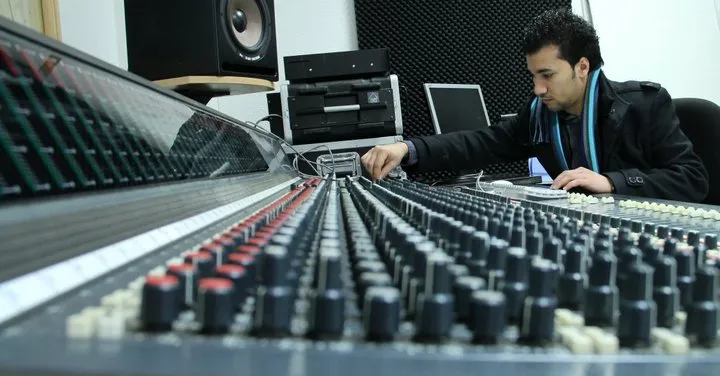
Photo: Ahmed Maalaoui, CC BY-SA 3.0, via Wikimedia Commons
You know the sound. It usually shows up before the logo finishes rendering — three notes, maybe a marimba, maybe a breathy synth pad with a little click on the front for punctuation. Play it in a crowded bar and half the room will turn their heads. Ask those same people to name the company and you get a shrug.
That gap — total recall, zero identification — is basically the job description at the small American studios that design audio identities. They aren't writing songs. They're building a two-second asset that has to work on a phone speaker in a parking lot, hold up in court, and lodge itself somewhere behind your left ear for the next decade.
The Brief Usually Fits in a Text Message
Most gigs start with a sentence instead of a spec sheet. Warm but not childish. Confident without being a drum fill. Something that sounds like the inside of a library at 9 a.m. A studio of three to six people will read that and go into a room with a laptop and a MIDI keyboard, and by Friday there are forty candidates.
By the following Tuesday, there are six. And all six sound, to an untrained ear, nearly identical — which is the point. The differences live in the last twenty milliseconds: whether the final note resolves or hangs, whether the transient has a click, whether the reverb tail is short enough to loop under a loading spinner without turning into mush.
Then They Play It Through a Bad Speaker on Purpose
The part clients never see is the degrade test. Engineers bounce each candidate and play it back through a phone speaker at 60 percent volume, a five-year-old laptop, a television set to level six, and a car stereo with the bass all the way down. They fold it to mono. They play it from another room, with a refrigerator running.
Most ideas die here. Anything below roughly 200Hz evaporates. The 200-to-500Hz zone turns into a brown smear. What survives is the 2kHz-to-4kHz band, which is why so many of these chimes read as bright, thin, and slightly brittle on studio monitors — they were never mixed for monitors. A wide stereo ping-pong delay sounds gorgeous on headphones and turns into nothing on a phone. So you write hard-panned elements that collapse cleanly, or you don't write them at all.
A Two-Second Limit Is a Compositional Form
The industry runs on a handful of standard lengths: a one-second click for interface feedback, a three-second end tag, a six-to-eight-second piece for advertising. The short ones aren't clips of the long ones — they're built from the same DNA with different physics.
Interval choice matters more than instrumentation. A rising perfect fourth reads as open and hopeful. A major third reads friendly, almost childlike. A flattened second creates unease, which is great for a thriller trailer and terrible for a bank. And there's a short list of moves that have been done so many times they now sound like the category itself — the ascending three-note major arpeggio, the descending two-note minor fall. Designers call this “scoring the cliché” and then spend a week trying not to.
The Hum-Back Test
Before anything gets approved, it goes to a panel. Typically 150 to 300 people, recruited fast, heard blind. They're asked to listen once, then answer questions at twenty-four hours and again at three days. Did you recognize it? Could you hum it into your phone? Would you be annoyed to hear it forty times a day?
The scores get plotted on two axes: recall and likability. A mark that scores 90 on recall and 40 on likability gets cut apart and rebuilt, because a chime you remember and hate is a liability with a melody. Studios also track something they call “unaided reproduction” — the percentage of listeners who can sing it back unprompted. That number is the closest thing the field has to a passing grade.
Paperwork for a Noise
Then comes the unglamorous half. In the US, a sound can be a trademark. Filings with the Patent and Trademark Office require an audio file, a description — often in musical notation — and evidence the sound actually functions as a source identifier in commerce. The famous ones are famous for a reason: the NBC chimes, the MGM lion, the Intel bong, the Harlem Globetrotters' signature whistle. Those filings took years and, in some cases, decades of continuous use.
Before any of that, there's a clearance search, because a three-note figure you wrote in an afternoon may sit uncomfortably close to something a competitor registered in 2004. Composer agreements split roughly in two: a flat work-for-hire buyout, or a fee plus a slice of the licensing revenue when the mark gets re-cut for a new market. Budgets run from about $15,000 for a startup's single chime to well past $200,000 for a full audio identity system.
Why It Still Behaves Like Music
Here's the part that keeps the job interesting. A good sonic logo follows the same rules as a phrase of melody. It has a beginning, an approach, and an arrival. It can end on a stable note and feel finished, or stop one step short and leave you slightly unsatisfied in a way that makes you lean in.
And it's never one file. The deliverable is a family: a one-second version, a three-second version, a seasonal variant, a quiet version for night-mode interfaces, a version with the vocal texture pulled out because the voice actor's contract expired. All of them engineered to feel like the same object at different distances.
Which is why the best of them don't scan as corporate at all. They scan as music — tiny, ruthlessly edited, legally protected music that you'll hum for twenty years and never once attribute correctly.