Ink, Squeegee, Repeat: The Ohio Garages Printing Your Band's Most Valuable Souvenir
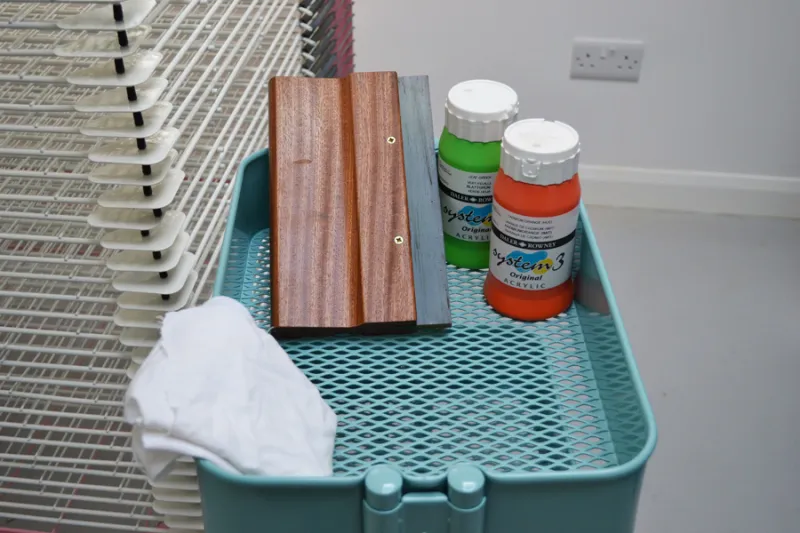
Photo: Scrud123, CC BY-SA 3.0, via Wikimedia Commons
There's a moment, usually around 10:40 on a Tuesday morning, when the color gets decided. Not by a committee. Not by a brand team. By one person in a garage outside Columbus, holding a pint of mixed ink up to the window light and squinting at it like it owes them money.
That person might be the reason the poster on your wall exists.
The Five-Hundred-Print Economy
Here's the strange math of the modern gig poster: a band can fill an arena, but nobody in that arena's infrastructure — not the label, not the promoter, not the massive merch conglomerate handling their T-shirts — wants to print 500 pieces of paper with eight colors on them. It's too small for the big shops and too weird for the print-on-demand pipelines.
So it falls to a loose network of small studios scattered through the Midwest and the Pacific Northwest, places with names like hand-painted signage and presses older than the drummers they're printing for. These shops live in the gap between "too big to notice us" and "too niche to print anywhere else," and that gap turns out to be a genuinely viable business.
The economics are simple enough to fit on a napkin. A shop prints a run of 200 to 600 posters for a show, the band signs a portion, and whatever doesn't sell at the merch table goes online after doors open. A $40 poster becomes a $90 poster by midnight. A variant colorway — same art, different ink — becomes $140. Scarcity isn't a side effect of small-batch printing; it's the product.
Paper Is a Personality Trait
Ask any of these printers what separates their work from a Kinkos job and they will talk about paper the way sommeliers talk about soil.
French Paper Co. out of Niles, Michigan, is the undisputed church of the scene — a sixth-generation family mill whose stock shows up under probably half the posters you've ever coveted. The weight, the tooth, the way ink sits on top of it instead of soaking in: none of that photographs well, and all of it matters in person. Collectors can identify a print's paper stock by feel before they've looked at the art.
Then there's the numbering. That little hand-scribbled "137/250" in the corner does something psychologically fascinating — it converts a souvenir into an edition. The poster stops being a memory of a night and becomes a finite object with a position in a sequence. Nobody frames a receipt. Everybody frames a numbered print.
One Drop, Start to Finish
Follow a single job through a shop and you start to understand the obsession.
Tuesday: the art arrives, usually from a designer the shop has worked with for a decade, someone who has drawn the same band five times and refuses to repeat a composition. Wednesday: screens get burned, one per color, and the registration — the alignment of every layer — becomes the day's entire personality. Off by a millimeter and the whole run goes in the recycle bin.
Thursday into Friday: printing, color by color, each layer needing to cure before the next goes down. A six-color poster is six passes. Six chances to ruin everything. The good shops print fast and check obsessively.
Saturday: the drop. Posters go up at the venue around 5 PM. By 5:20, the ones signed by the band are gone. By the time the headliner walks onstage, the shop's webstore is live and the online allocation sells out during the second song. The printer finds out from a text message because they're still cleaning screens.
From Merch Table to Gallery Wall
What started as roadie-adjacent side hustle money has quietly become a legitimate collecting market. There are conventions — Flatstock, running alongside SXSW for years, where the printers themselves set up booths. There are grading debates, secondary marketplaces, collectors with climate-controlled flat files. A mint condition early print from a marquee-name show can trade for four figures, which is a sentence that would have been laughable in 2003.
The bands, to their credit, mostly get it. Even the enormous ones. There's something about a hand-pulled print that resists the algorithm — it can't be streamed, it can't be replicated infinitely, and it smells like ink for about a week.
So next time you're at a show and see a line wrapped around the merch table for pieces of paper, know what's behind it: a garage in Ohio, a window-lit pint of mixed ink, and somebody squinting at a color at 10:40 on a Tuesday, getting it exactly right.