The Booth That Outlived the Band: Inside America's Studios and the One Room Nobody Books
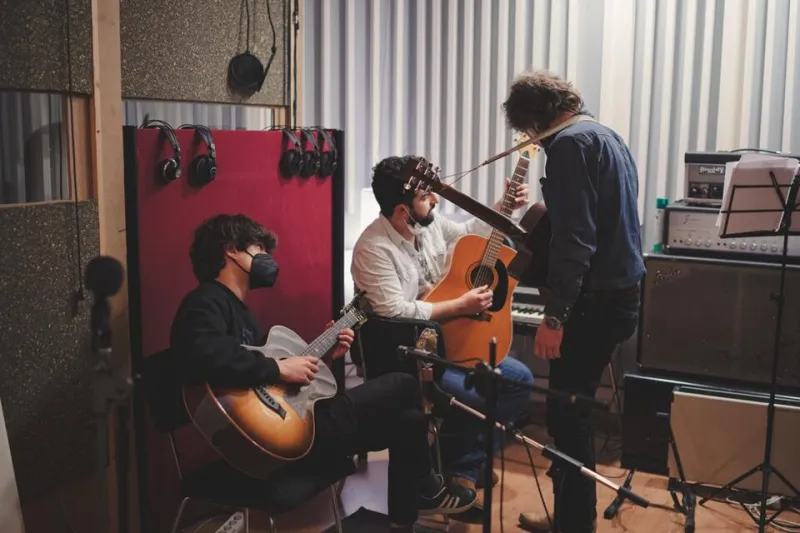
Photo: WastedTimeBoy, CC BY-SA 4.0, via Wikimedia Commons
Walk into almost any commercial recording studio in America and ask for the tour. You'll get the control room, all glow and faders. You'll get the live room, big and proud, maybe with a drum kit set up like it's expecting company. And then, almost always, someone will gesture down a hallway toward a closed door and say the same thing: "Oh, that one? We don't really use that anymore."
Every studio has a room like this. The iso booth with a single dead XLR jack. The vocal room from the original 1978 build-out, all carpet and parallel walls, that nobody has touched since the Carter administration. The drum annex that was state of the art when it was built and is now, functionally, a very expensive closet.
These rooms aren't abandoned. They're maintained. They're heated, insured, cleaned, and counted in the lease. They're just never booked. Which raises an obvious question: why do they still exist?
The Room That Costs Money to Ignore
"People think a dead room is just, you know, dead," says a studio manager we'll call Dana, who runs a mid-size facility outside Nashville and asked not to use her studio's name because "the landlord reads everything." "But that room is on the floor plan. It's in the insurance valuation. It's in the acoustic report the architect did in 1981. You don't just knock out a wall because it's quiet in there."
That's the first and least romantic reason these rooms survive: paperwork. Commercial studios are often built into spaces with complicated zoning, sound transmission agreements with neighbors, and fire code approvals that were granted for a specific layout. Renovating one room can trigger a review of the whole facility. For a business running on thin margins and session bookings, a renovation that might require the studio to close for weeks is a bigger risk than a room that just sits there.
There's also the acoustic irony at the heart of it: a badly designed room is expensive to fix precisely because it's badly designed. Pulling out 1978 carpet, treating parallel walls, redoing the isolation — that's real money spent on a room that might still be acoustically mediocre afterward.
The Superstition Tax
But paperwork alone doesn't explain it. Talk to enough studio people and you start hearing stranger reasons.
"That booth is where we track scratch vocals," one engineer in Chicago told me. "And one time a band cut a real take in there and it ended up on the record. So now nobody wants to jinx it by changing anything." The room in question had a broken cable snake, a busted light, and a folding chair that has apparently been there since 2009. It has also, by local legend, appeared on at least two platinum records.
Studio culture runs on superstition the way kitchens run on caffeine. Amps that must be warmed up a specific way. Couches that cannot be moved because a famous session happened on them. A dead room becomes a shrine precisely because it's unused — its legend is untouchable as long as nobody tests it. Booking the room risks finding out it sounds like a parking garage. Leaving it alone preserves the story.
And the story has value. Several managers admitted the dead room is a sales tool. "When we give tours, that room is part of the history," Dana says. "People love a room with a past. It makes the place feel real. You can't charge extra for it, but you can absolutely use it to close a client."
The Sessions That Finally Book It
So what wakes a dead room up? Almost always, necessity plus a deadline.
The classic scenario: a big live room is occupied by a full band tracking basics, and the vocalist needs to cut overdubs right now, and the only quiet space left is the booth nobody touches. Suddenly that weird, dead-sounding, slightly haunted room is the only option — and here's the twist that every engineer eventually discovers: sometimes it's perfect.
Dead rooms are dead for a reason. That over-treated, over-carpeted, aggressively dry vocal room from 1978? With a modern mic, a decent preamp, and reverb added digitally, it can sound cleaner than a prettier room. The flaws that made it unbookable — the boxy dimensions, the flutter echoes — were fixed by thirty years of software nobody could have predicted.
"The best vocal I ever tracked was in a room we jokingly called the panic room," a Denver engineer told me. "It was built for overdubs in the '90s and abandoned by 2005. We threw a singer in there at 2AM because nothing else was free, and it just worked. Zero reflections. Total silence. The HVAC was even broken, so it was quiet."
Keep the Room
There's a lesson in all this that goes beyond studios. Every creative space accumulates rooms that stop being used — the storage corner that used to be a booth, the annex that used to be an edit suite. The instinct is to clear them out, optimize, make everything earn its square footage.
But the people who run these places mostly don't. They keep the broken cable and the folding chair and the legend. Not out of laziness, exactly, but because a space with a dead room in it has slack in it — somewhere for a 2AM session to land, somewhere for the story to live.
The next time you're on a studio tour and someone waves vaguely at a closed door at the end of the hall, ask about it. There's almost always a story. And every so often, there's a session that books it, one take gets kept, and the dead room earns another decade of being left alone.