Please Stay on the Line: The Guy Who Treats Hold Music Like Fine Art
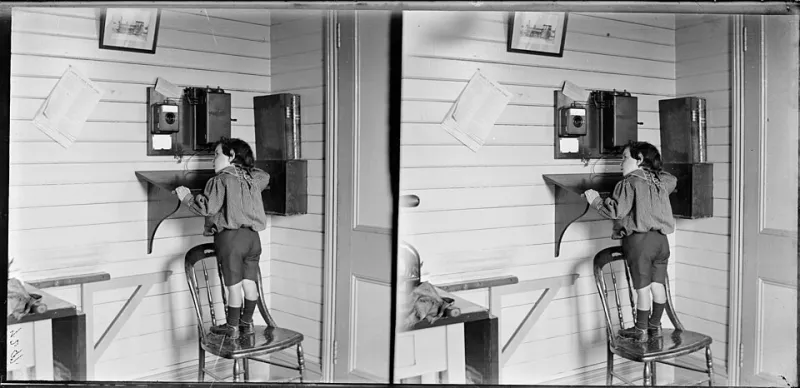
Photo: National Library NZ on The Commons, No restrictions, via Wikimedia Commons
There's a moment — usually around minute eleven of waiting to dispute a cable bill — when the hold music stops being background noise and starts being a place. You know the one. A keyboard preset that hasn't been manufactured since 1989, a bassline that loops every forty seconds, a saxophone that sounds like it's being played through a wall. It's not good, exactly. But it's something.
Dale Hensley thinks about that something more than anyone you will ever meet.
The Archive Nobody Asked For (And Everybody Needs)
Hensley, a retired telecom technician from Dayton, Ohio, has spent the past nine years cataloguing hold music. Not casually. Obsessively. His spreadsheet — which he refers to, without irony, as 'the vault' — contains more than 2,400 entries: airline queues, utility hotlines, hospital billing departments, the IRS. Each entry includes the company, the date he called, the estimated track title, and, when he can find it, the actual licensing source.
'I started because I heard the same track at a dentist's office and my bank,' he told me over the phone, which, naturally, he recorded. 'Two completely different industries, same sax. Somebody's selling that. Somebody's buying that. I wanted to know who.'
The answer turned out to be a small, weirdly durable industry. Companies don't write hold music. They license it — often from production music libraries, the same outfits that score infomercials and local news bumpers. A track that plays for millions of frustrated Americans might have been written in an afternoon by a session musician who has long since forgotten it exists.
What Makes a Hold Track Actually Work
Here's the thing Hensley discovered that most of us never bother to notice: hold music is engineered, not composed. The good ones — and yes, there are good ones — follow a set of unspoken rules.
No big drops or hooks. A memorable melody is a trap. If the song grabs you, the loop becomes torture by the fourth rotation. The best hold tracks are pleasant enough to occupy your ear and forgettable enough to survive an hour.
Mid-range everything. Phone lines compress audio brutally. Anything too low gets swallowed; anything too bright turns to static. That's why hold music lives in that mushy middle — the sonic equivalent of beige.
Loops that don't announce themselves. The gold standard is a seam you can't hear. Hensley has timed loops down to the second and keeps a personal ranking of 'seamless' versus 'seam-y.' He is not embarrassed about this. I checked.
Why Throwaway Music Hits So Hard
There's a reason hold music feels oddly emotional, and it's not nostalgia for something you never experienced. It's context. You hear hold music when you're in limbo — stuck, powerless, waiting for a stranger to fix something you can't. The track becomes glued to that feeling.
Hensley puts it better: 'It's the sound of America on pause. Everybody's calling about the same stuff — money, health, flights that got cancelled. The music doesn't know that, but it absorbs it anyway.'
That's why a generic keyboard ballad can hit like a memory. It's not the notes. It's everything you were doing while the notes played.
The Ethics of Paying to Soften Pain
Here's where it gets strange. Companies pay licensing fees — sometimes annual ones — for the privilege of making your wait marginally less miserable. There's an entire pitch deck economy built on 'hold experience optimization.' Some firms A/B test their queues the way streaming services test thumbnails.
Hensley is ambivalent about it. On one hand, he thinks it's genuinely humane — a small acknowledgment that waiting is awful. On the other hand, he notes, 'The cheapest thing a company could do is answer the phone. The music is a bandage on a decision they already made.'
He archives anyway. Because someday, a track will get swapped out, the license will lapse, the loop will vanish — and if nobody saved it, it'll be like it never hummed at all.
Somewhere in Dayton, there's a spreadsheet with your dentist's hold music in it. It was important to him. Your call was important to him.