Your Wedding Band Learned 200 Songs for This Exact Moment
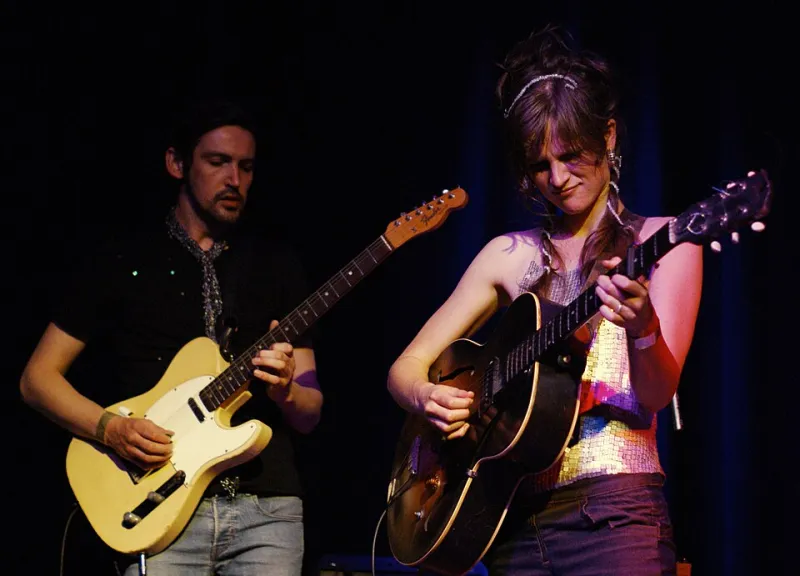
Photo: Phil King, CC BY 2.0, via Wikimedia Commons
There's a moment at every wedding — usually around 10:40 PM, right after the cake cutting, when the dance floor is at maximum chaos — where the band gets tested. Somebody's uncle bellows out a request for something nobody has thought about since 1997. The frontwoman nods. The drummer counts it off. Four bars later, the uncle is weeping on the dance floor.
Nobody in that room understands what just happened. But the musicians do: that was one of roughly 200 songs living in their heads, rent-free, ready to deploy on command.
The Catalog Is the Job
Ask a wedding bandleader how many songs their group knows and you'll get a number delivered like a business stat, because that's what it is. Three hundred. Two-fifty. One guy in Nashville told me his seven-piece outfit maintains "somewhere north of 400, but we only trust ourselves with 300."
The learning process is unglamorous. New additions to the catalog get rehearsed in living rooms and rented practice spaces, charts scrawled in pencil, form memorized in sections — verse, pre-chorus, the key change everyone forgets. The goal isn't note-perfect replication. It's shape. A wedding band needs to know where a song breathes, where it builds, and exactly which eight bars will make a room full of strangers scream the lyrics at each other.
And the requests come blind. The setlist is a suggestion, not a contract. A good band reads the floor in real time and pivots — from Motown to early-2000s pop to a country singalong — without letting the energy dip for even one transition.
What America Actually Wants to Hear
There's a canon, and it barely changes. "September" by Earth, Wind & Fire is the undisputed king — nearly every bandleader I spoke with called it the closest thing to a guaranteed floor-filler in American music. "Mr. Brightside" has become the generational handoff song, the moment millennials finally out-scream their parents. "Shut Up and Dance," "Don't Stop Believin'," Whitney's "I Wanna Dance with Somebody" — these aren't requests so much as reflexes.
The regional wrinkles are real, though. Boston crowds want "Sweet Caroline" and will accept no substitutes. Texas weddings run country-heavy all night. D.C. and Atlanta audiences expect go-go or trap medleys worked into the third set. A touring wedding band is essentially a folklorist with a pedalboard.
The first dance is the one song they'll rehearse to the letter — couples send exact live versions, edited intros, sometimes full transcriptions. Everything else stays loose.
The Artistry Nobody Applauds
Here's the thing that surprised me most: the best wedding musicians are often the best musicians, full stop. The gig pays better than most club work, often beats touring rates, and demands a versatility that session work only sometimes requires. On a given weekend, the same bassist might cover disco, funk, hair metal, and a Frank Sinatra set during cocktail hour without breaking stride.
The craft is in the disguise. A great wedding band makes 200 songs sound effortless, like the music simply lives in the air and they're just catching it. The transitions are engineered — matching tempos, crossfading keys, ending one chorus into the downbeat of the next. It's arrangement, improvisation, and crowd psychology running simultaneously, all in a tuxedo, all while a bridesmaid stands on a chair filming vertically.
The Economy of the Living Playlist
The business side is its own ecosystem. Top-tier bands in major markets — New York, Chicago, L.A. — command five figures for a night. The leader takes a cut for the booking, the admin, the endless client emails about whether the father-daughter dance can be a mashup. The players split the rest. Everyone's a freelancer; the band is less a fixed group than a roster deployed by geography and availability.
And there's a quiet irony at the center of it all: in the streaming era, when any song is instantly available to anyone, the live version has become a luxury good. People aren't paying for the music — they can hear "September" for free in their kitchen. They're paying for the moment. The collective sweat, the singalong, the uncle in tears. The band sells the room, not the song.
Which might be the most artistically honest gig in America. No albums, no streams, no bylines. Just 200 songs in your head and four hours to make strangers dance.
The best ones wouldn't trade it for anything. As one drummer put it, packing his kit into a minivan at 1 AM: "Nobody's ever left one of our shows crying happy. Well — except every single week, actually."
That's the human jukebox economy. And business, as far as anyone can tell, is booming.