Rail Riders: The People Who Hold Down the Front Row So You Can Lose Your Mind
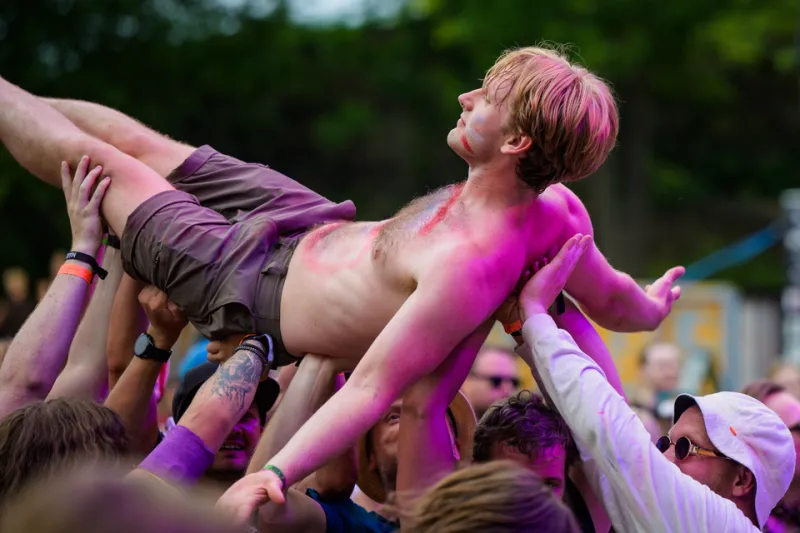
Photo: Birgit Fostervold, CC BY-SA 4.0, via Wikimedia Commons
There's a moment at every general admission show, right before the lights drop, when the crowd compresses like a junk compactor. Bodies shuffle forward. Elbows negotiate. And at the very front, hands already hooked over the barricade, stand the same kind of people who are always there: the rail riders.
You know who I mean. The person who's seen the band eleven times this tour. The teenager who got in line at 9 a.m. for an 8 p.m. door. The forty-something who knows exactly which security guard works stage left and greets them by name. They are the load-bearing walls of the pit, and honestly, live music in America would collapse without them.
The Setlist Is a Study Guide
Ask a rail regular about their preparation and you'd think you were talking to a med student before boards.
"I'll run the last three setlists the night before," says Dana, 26, a self-described "pit rat" who's held the rail for everyone from a screamo band out of Richmond to a synth-pop act from Portland. "Not to know the songs. To know the sequence. If they've been closing with the deep cut from 2019, I want to be emotionally ready for that."
This isn't casual fandom. This is homework. Rail riders trade setlist rumors on Discord, track openers' runtimes to estimate when the headliner hits, and know that night two of a run usually means a shakeup. When the band deviates from the script, the front row is the canary in the coal mine — the collective gasp travels backward through the room like a wave.
Rail Real Estate
Venue staff will tell you plainly: the front three feet of a stage is the most contested territory in the building.
"People treat that rail like it's deeded property," laughs Marcus, a house manager at a 1,200-cap club in Chicago. "We've had folks tape a piece of paper with their name on the barricade. We take it down, obviously. But I respect the commitment."
The economics are brutal and well understood: spots go to whoever pays in hours, not dollars. Camp out through two openers, endure the standing, the dehydration, the person behind you narrating every song transition — that's the price of admission. And the veterans will tell you the trade is fair, because the rail offers something no ticket upgrade can: proximity that changes the show itself.
"From the rail, you don't watch a concert," Dana says. "You watch a person decide, in real time, to give their whole life to this. That's different."
The Etiquette Nobody Wrote Down
Here's the thing about pit culture: there is a code, it is strictly enforced, and it appears on no website.
The big ones, per multiple veterans and a security guard who asked to remain anonymous because he's "not paid to be a philosopher":
- You don't shove past someone who's been there longer. The rail is earned in hours.
- If someone goes down, the whole front row becomes a rescue team. Hands up, human chain, pass them over the barrier. This happens in seconds and it happens every night.
- You watch your elbows during the heavy stuff. The rail is shared space, not a weapon.
- You don't hog the artist when they lean in. One touch, one second, then rotate.
- You hydrate. "Nothing ruins the code like a faint," Marcus says. "We'd rather you leave for water than become an incident report."
The rescue thing deserves emphasis. Multiple staff members told me the front row routinely spots trouble before security does — a panicked face, a lost balance — and the pass-over-the-barrier maneuver is so standardized it might as well be in the employee handbook.
Why It Matters
There's a temptation to romanticize these folks as superfans and stop there. But their function is bigger. A pit with experienced regulars at the front is a safer pit. Energy radiates backward from the rail; when it's confident and generous, the whole room breathes easier. Touring acts notice it too — the front row is the feedback loop a performer plays to on the off nights when the middle of the room is checking their phone.
So the next time you roll in at door time and slide into a comfortable spot mid-venue, spare a thought for the people who've been pressed against that barricade since lunch, holding the line, learning the setlist, quietly running crowd control. They're not the show.
They're what makes the show possible.