Hitting a Piece of Metal Against Your Knee Is Officially a Production Technique Again
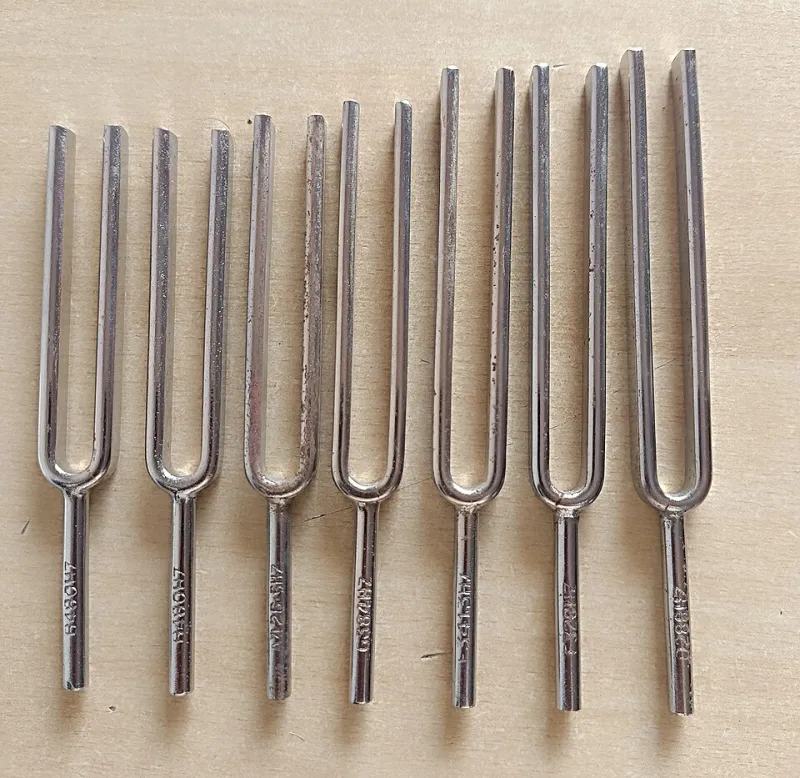
Photo: K.Venkataramana, CC0, via Wikimedia Commons
There's a video making the rounds of a producer in a cluttered Los Angeles bedroom studio striking a tuning fork against the edge of a desk, pressing the handle against a microphone body, and capturing a pure, wavering A440 that no plugin on Earth can fake. The comments are split between witchcraft and my grandfather had one of these in a drawer. Both are right.
Welcome to the strangest gear trend of the decade: a generation of American bedroom producers and boutique designers deliberately reaching for tools their grandparents were happy to throw away. Tuning forks. Cassette four-tracks. Razor blades and splicing tape. Even Optagons — the honeycomb-shaped acoustic diffusers that used to hang in broadcast studios — are being scavenged off eBay and bolted to bedroom walls.
Nobody needed this to happen. The DAW can do everything. That's exactly the point.
The Infinite Menu Problem
Talk to producers under 30 who've gone analog-partial and a pattern emerges fast. It's not nostalgia — most of them never touched this stuff the first time around. It's decision fatigue.
"I had 400 plugins and I opened the same three," says Marisol Vega, a producer in Chicago who scores short films from a converted closet. "Every session, I'd spend an hour auditioning reverbs that all sounded ninety percent identical. Now I have one tape machine, one spring reverb, and a fork. My first take is usually my best take, because there's nothing left to audition."
Designers describe the same phenomenon in visual terms. A Brooklyn studio that does album art and merch has started printing runs on a decades-old photocopier — not because it's cheaper, but because the machine's banding and misregistration give every poster a fingerprint. "The copier has taste," one of them told me, only half-joking. "Bad taste, but taste."
There's a term floating around design circles for this: constraint as a luxury good. When anyone can generate infinite options, the scarce resource is a reason to stop looking. Old tools come with a stop built in.
The Fork Is a Metronome That Breathes
The tuning fork deserves its own paragraph, because it's the least obvious and most telling piece of the revival.
Producers are using forks less for tuning — everything gets tuned digitally anyway — and more as a reference tone and a physical exciter. Strike the fork, touch it to a guitar body, a mic clip, a windowpane, and you get a sustained pure tone that interacts with the room. Some use it to tune drum kits by resonance. Some record the decay as a drone bed. One producer in Nashville reportedly tunes her whole mix around a fork her grandmother used in a church choir.
What the fork offers that a plugin doesn't is friction. You have to stand up. You have to hit it. It rings differently every time because the room is different every time. In a workflow built on undoing, it's a tool that only does things once.
Cassette Loops and the Art of the Happy Accident
The cassette revival is older and better documented — the lo-fi wave made its peace with tape hiss years ago. But what's happening now is more specific than hiss-as-aesthetic. Producers are building actual loops: cutting tape with razor blades, splicing it into circles, and letting it run through the deck until it degrades.
The workflow is closer to sculpture than software. You commit sounds to tape, you cut them, and the splice either works or it doesn't. There's no automation lane. There's no version history. A loop that survives twenty passes through the deck comes out the other side a different recording — softened, wobbled, occasionally improved in ways nobody could have programmed.
"It's the opposite of a preset," says a Portland-based producer who releases entire EPs built from a single looped cassette. "A preset is a promise that someone else already liked this sound. A splice is a bet. Sometimes you lose. Losing is part of the product."
Optagons and the Bedroom That Sounds Like 1962
Then there's the acoustic side. Optagons — those flower-shaped plywood diffusers from mid-century radio studios — have become the status object of a certain kind of home studio. Not foam wedges, which absorb and deaden, but diffusers, which scatter sound and keep a room feeling alive.
The appeal is partly acoustic and partly architectural. An Optagon on a bedroom wall says something: I care about this room as a room. In a scene where the studio is often a corner of a rental apartment, decorating with broadcast relics from the '50s is a design statement as much as a sonic one. It's the audio equivalent of a vintage Eames chair, except it might genuinely make your vocals sound better.
Limitation Isn't a Bit. It's a Budget.
The cynical read is that this is all branding — obsolete gear as influencer prop. And sure, some of it is. But spending time in these rooms, the practical case keeps surfacing: old tools are cheap, unbreakable, and finite.
A working fork costs twelve dollars. A functional cassette deck runs less than a mid-tier plugin bundle. And when your gear can only do one thing, you stop negotiating with yourself about what to make. The limitation does the editing that a hundred YouTube tutorials keep promising.
There's also something quietly American about the whole thing — a country that invented the garage band now building garage studios out of the wreckage of its own broadcast history. The tools didn't survive because they were sacred. They survived because somebody's uncle never cleaned out the attic.
The fork rings. The tape splices. The Optagon scatters the sound around a bedroom in Ohio that cost $700 a month. None of it is better than the plugins, and none of it is trying to be. It's just slower, weirder, and finally yours.