Nobody Touches the Brown Amp: A Love Letter to Gear That Refuses to Die
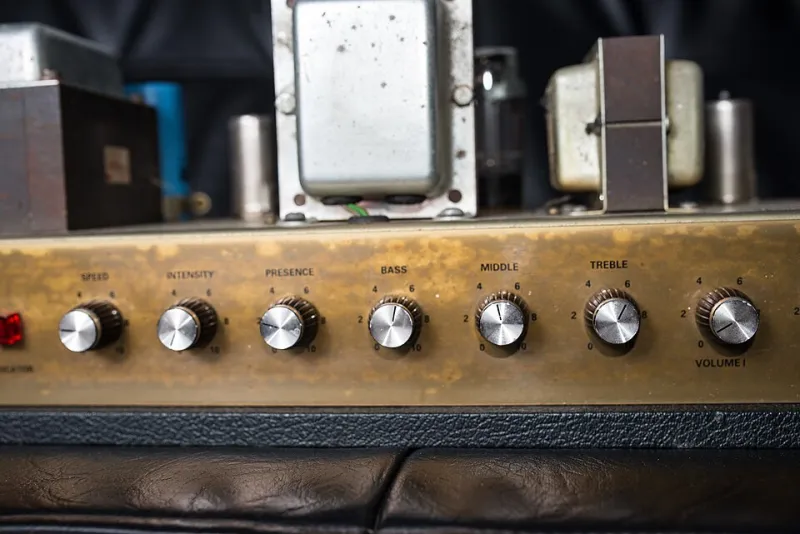
Photo: Shixart1985, CC BY 2.0, via Wikimedia Commons
There's a combo amp in the back room of a 250-cap club in Columbus, Ohio, that has been there longer than anyone currently on payroll. It's covered in a shag carpet that stopped being fashionable around the Carter administration. The grille cloth is torn. One of the knobs is actually a bolt from a hardware store. Bands ask about it by name.
Nobody at the club can tell you exactly when they bought it. Nobody is allowed to sell it, either. This is what people in live music call "the magic box" — and every venue in America has some version of it.
The Superstition Is the Spec Sheet
Ask a modern audio engineer what makes a room sound good and they'll give you a measured answer: coverage, room modes, headroom, proper gain staging. Ask them why the house backline still includes a 1970s tube head with a questionable power switch, and the answer changes shape entirely.
"I can't show you a graph that explains it," says a longtime stagehand we'll call Danny, who has loaded in at theaters and dives across the Midwest for two decades. "I can tell you that when a guitar runs through that old thing, the singer stops fighting the mix. I don't know why. Nobody knows why. That's kind of the point."
The science, for what it's worth, isn't pure voodoo. Old transformers, hand-wired circuit boards, and components that have aged like whiskey all behave differently than their modern equivalents. Tube amps clip in a warm, compressed way that digital modeling has spent decades trying to reverse-engineer. A console from 1978 might measure noisier than a laptop rig, but its preamps color the sound in ways engineers have learned to mix around — and even with.
But measurement only gets you halfway. The rest is muscle memory.
Institutional Knowledge, Wrapped in Tolex
Here's the part that rarely makes it into the gear forums: the magic box isn't just hardware. It's a relationship.
A sound engineer who has mixed on the same ancient desk for fifteen years knows its quirks the way a driver knows a stick shift. They know channel six runs hot. They know the EQ has a sweet spot at 2 o'clock. They know that if you let the thing warm up for twenty minutes, the whole board settles into itself. Swap in a shiny modern equivalent with better specs across the board, and you've also swapped out fifteen years of earned intuition.
"You're not buying equipment," Danny says. "You're buying the engineer's comfort. And comfort sounds good."
That's why venue owners — a famously frugal species — will quietly spend real money maintaining gear that has no business being worth anything. Re-capping a forty-year-old amp can cost more than a new one. They do it anyway, because the alternative is telling every touring act that rolls through town that the house sound just changed.
The Cables Have Names
The devotion extends all the way down to the junk drawer.
Talk to enough stagehands and you'll hear about the long black cable that's been spliced so many times it's mostly electrical tape by mass. You'll hear about the DI box held together with gaffer tape and prayer that "just sounds right on bass." These aren't jokes, exactly. They're also not entirely not jokes.
There's a real psychological component here. Live sound is high-pressure, low-control work. Engineers get one soundcheck, a room full of variables, and maybe forty-five minutes to make a stranger's music feel like a record. In that environment, ritual is a feature, not a bug. The beat-up amp that always works is a rock in the stream. Superstition is just confidence wearing a costume.
When the Relic Finally Dies
Of course, the magic box mythology has a dark side. Sometimes ancient gear is just old gear — underpowered, unreliable, and held together by a house engineer's refusal to admit defeat. Bands have watched a vintage head catch fire mid-set. Venues have lost entire weekends to a console that chose the worst possible moment to retire.
The clubs that last tend to land on a compromise: modern PA and monitoring where it counts, one or two beloved relics where it matters to the room's identity. The old amp stays in the back line not because it measures well, but because it's theirs. It's the reason a band from Seattle can roll into Ohio, plug into that carpeted monster, and say the sound reminded them of somewhere they played in 2009.
That's not a specification. That's a design decision — one made with solder, duct tape, and forty years of Friday nights.
So if you ever find yourself backstage watching a stagehand unplug something that clearly should have been scrapped a decade ago, leave it alone. You're not looking at clutter. You're looking at the house's whole personality, humming quietly in the corner, waiting for soundcheck.