Three Weeks, One Piano, Zero Applause: Life on the Road With the Guy Who Tunes for Rock Stars
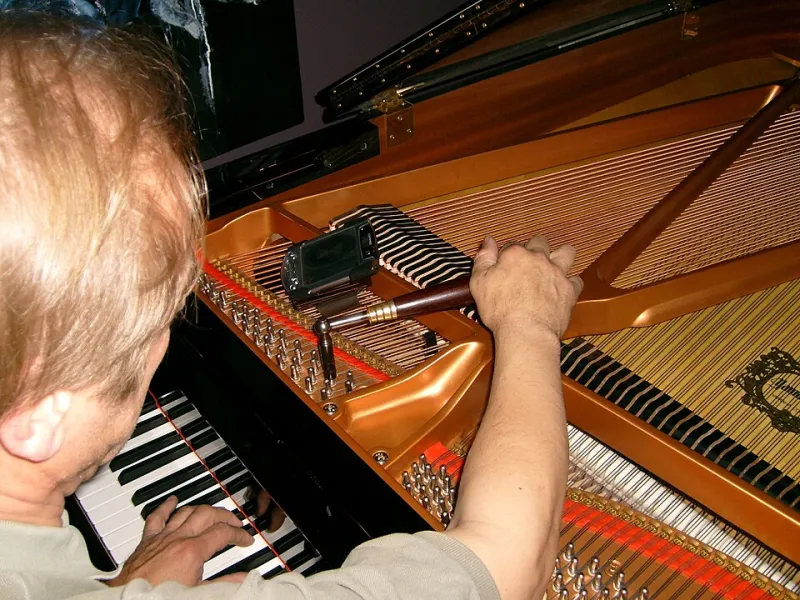
Photo: PlayMistyForMe, CC BY 3.0, via Wikimedia Commons
The piano arrives at the arena at 6:40 in the morning, strapped upright inside a black road case the size of a garden shed. By 7:15, Ray Delgado has the lid off, the lid on removed, and his ear about six inches from the strings. By 8:00, he's sweating. By 8:30, he's done — and by that night, when 16,000 people in Dallas hear the opening chords of a classic rock deep cut, none of them will know his name.
That's the deal. That's always been the deal.
The Road Doesn't Care About Your Perfect Tuning
Here's the thing nobody tells you about a piano on tour: it's basically a 990-pound mood ring. Humidity in Houston, dry air in Denver, the vibration of a semi crossing Kansas — every mile and every climate zone pulls those strings in a different direction. A piano tuned perfectly in a rehearsal space in Los Angeles will arrive in Phoenix sounding like a saloon in a spaghetti western.
"People think tuning is about perfection," Ray tells me over gas station coffee in a loading dock that smells like diesel and confetti. "It's not. Tour tuning is about survival. I'm not chasing perfect. I'm chasing 'still sounds good at 10:45 PM after the pyro's been cooking the stage all night.'"
There's a phrase for it in the trade — "rock'n'roll tuning" — and it means exactly what it sounds like. Stretch some of the intervals slightly so the instrument cuts through a wall of guitars. Lock in the octaves so hard they'll hold through a soundcheck, a support act, and two hours of a frontman jumping on the case. Perfect is for the studio. Durable is for the road.
A Trade With Maybe 200 Practitioners Left
Concert piano tuning has always been a small profession. Road tuning — the specialty of keeping an instrument show-ready night after night in buildings that hate pianos — is smaller still. Ray estimates there are "maybe a couple hundred people in the country" who do this regularly, most of them clustered around touring hubs like Nashville, LA, and New York.
The work exists almost entirely because of one stubborn genre: classic rock. Acts like Elton John's peers and the big legacy touring bands still want a real acoustic grand on stage — not a sampled keyboard, not a trigger pad. The sound of hammers hitting actual strings in an actual arena is part of the product. And that means somebody has to be there at 7 AM with a tuning lever and a flashlight in their teeth.
"The pianists can tell," Ray says. "Every one of them. They walk out during soundcheck, play four chords, and they know if I did my job. They never say anything. That's how I know it was right."
What Three Weeks on a Tour Bus Actually Looks Like
Ray's recent run looked like this: load-in at dawn, tuning by mid-morning, soundcheck notes at 3, show at 8, then pack the instrument back into its case while the crowd is still filing out. Then a 400-mile overnight drive to repeat it. Three weeks, fourteen cities, one instrument he describes as "my coworker, my patient, and occasionally my enemy."
The hazards are absurd and constant. Pyro rigs bake the stage and send the pitch drifting sharp. Fog machines dump moisture into the soundboard. One venue in the Midwest had a HVAC system that kicked on mid-show and detuned the treble in real time — Ray watched from the wings, arms crossed, doing math in his head about which strings would need attention during intermission.
And the pay? "It's not the money," he laughs, which is what everyone says, and then he mentions that a top road tuner can out-earn plenty of the musicians on stage. Fair enough.
Why He Keeps Doing It
I asked Ray the obvious question on the last night of the run: why follow a trade that's shrinking, in conditions designed to destroy the very instrument you love?
He thought about it while coiling a cable, then nodded toward the empty arena — the house lights coming up, the crew stacking road cases, the faint hum of the rig cooling down.
"Every night, someone in that crowd hears a grand piano in a place a grand piano has no business being. Maybe it's the only time in their life. Somebody put that piano there and made it sing. That somebody's me."
Then he closed the case, taped the latch, and went to find the coffee that passes for breakfast on a tour bus. The truck pulled out at 2 AM. Somewhere down the highway, the next arena was waiting, and the piano — stubborn, expensive, gloriously analog — was going to need him again by morning.