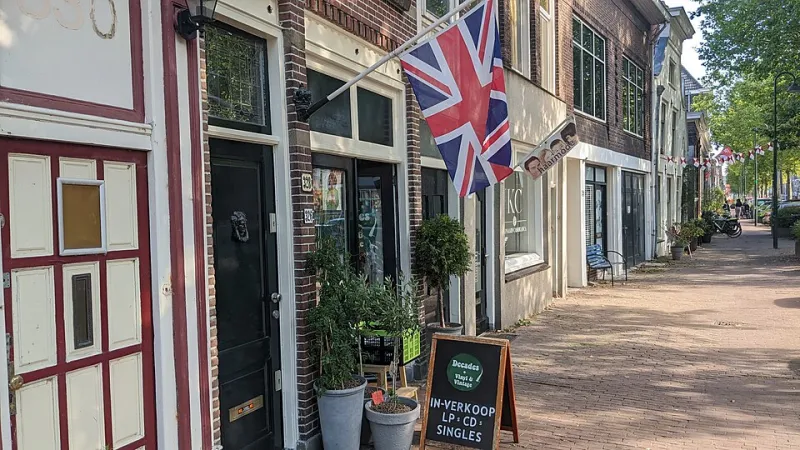
Shelf Life: The Gen Z Collectors Trading Playlists for Plastic
Photo: Internet Archive Book Images, No restrictions, via Wikimedia Commons
Somewhere in a Brooklyn apartment, a 23-year-old is carefully sliding a vinyl record out of its sleeve, holding the jacket up to the light like a museum piece. She has Spotify. She has AirPods. She has, in theory, access to roughly 100 million songs for the price of two lattes a month. So why did she just spend $38 on a record she's already heard?
The answer, it turns out, has less to do with sound quality than with something the streaming era quietly deleted: the object itself.
The Album Cover Got Its Body Back
For twenty years, music shrank. First it was a CD booklet, then a thumbnail, then a 64-pixel square on a phone screen while you scrolled past it. Physical media reverses that shrinkage. A record jacket is a foot of designed real estate. A cassette is a pocket-sized sculpture. A CD, improbably, has come back around as the scrappy underdog format — cheap enough to buy on tour, substantial enough to feel like a souvenir.
Gen Z didn't kill these formats. They inherited them like vintage furniture, and for the same reason: in a world where everything is a file, a thing is a statement.
There's also a design literacy angle that shouldn't be ignored. This is the generation that grew up making mood boards. They understand visual identity the way previous generations understood radio formats. An album that looks good on a shelf — that coordinates, that photographs well, that says something about its owner — has a competitive advantage that no algorithm can replicate.
Ownership as a Personality Trait
Ask a young collector what they're buying and they won't say "music." They'll say this music, this pressing, this variant. The limited run of 500 on seafoam splatter vinyl. The cassette with the alternate cover. The CD with the bonus track that never hit streaming.
Scarcity is doing a lot of work here, but so is identity. A playlist is anonymous; a shelf is a self-portrait. When your entire music life lives inside an app, the only way to make it visible is to pull it out of the app. The record crate has become the new bookshelf — a signal to visitors that says, in effect, I have taste, and here is the physical evidence.
There's something else, too: permanence as rebellion. Streaming licenses get renegotiated. Songs vanish overnight from catalogs. A record on your shelf can't be delisted. For a generation that watched digital things evaporate — games delisted, shows cancelled, accounts deleted — that permanence reads less like nostalgia and more like common sense.
Bandcamp Fridays and the New Ritual Economy
The infrastructure of this revival is distinctly internet-native. Bandcamp built a culture where buying music directly from an artist feels like a transaction and a handshake, especially on the promotional "Bandcamp Friday" days when the platform waives its cut. Record Store Day, once a boomer-nostalgia event, now sees lines of twenty-somethings camped outside independent shops from Portland to Philadelphia, hunting drops the way sneakerheads hunt releases.
Notice the pattern: these aren't passive purchases. They're events with calendars, queues, and community. The ritual is the product. Dropping a needle. Rewinding a tape. Even the mild inconvenience of flipping a record is part of the appeal — friction, in a frictionless world, reads as authenticity.
What 'Owning' Music Means Now
The old definition of ownership was about control: you owned the disc, so you decided when it played. The new definition is about connection. Owning a physical copy is a fan's way of saying this mattered to me enough to exist in my space. It's patronage with a receipt.
For artists, this reframing is a lifeline. Streaming pays fractions of a cent; a $30 LP sold at a merch table pays rent. The collectors know this, and many buy physical specifically because it routes money to the artist. The format is a tip jar you can display.
Will it last? Formats have died before, and hype cycles cool. But the smart money says this revival isn't about vinyl or cassettes at all. It's about a generation rebuilding the connection between music and the physical world — one beautifully designed, deliberately inconvenient square of cardboard at a time.